Over the last decade the relationship and collaboration between dentists and technicians has evolved, yet there is still more progress to be made by both parties. Each respective profession possesses its own knowledge and expertise accompanied by the shared goal of happy patients. Having said that, there’s a lot of room in between for misinterpretation, lack of communication, and fractured workflows. As dental laboratory technicians, it would be welcomed to have insight from a dentist who truly understood what is needed and accomplished on the lab side.
Miles Cone, DMD, MS, CDT, FACP, has his own practice, Nuance Dental Specialists based in Portland, Maine, and is a military-trained, board-certified prosthodontist, with dual-certification as a dental technician. He has been a frequent contributor to the JDT with articles and photos featured on the cover. As both a prosthodontist and CDT, Cone brings a unique perspective to studying both sides of the seeming dichotomy.
What inspired you to pursue both your dental license and the certified dental technician credential?
Throughout my formal training in residency, myself as well as the other prosthodontic students spent thousands of hours in the lab pouring models, layering ceramic, and festooning dentures. At the end of my three-year program, I only had my specialty certificate to show for all the blood, sweat, and tears. This should have been enough, however, my peers who were enrolled in other programs of study, periodontics, for example, came out of their journey with master’s degrees and publications in prestigious journals. Initially, my inspiration to have additional letters after my name was based on ego and envy – if I am being honest.
How do you ensure effective communication and collaboration between dental clinics and dental laboratories?
The challenges of effective communication between clinicians and technicians have been, and will continue to be, a source of frustration as long as dentists endeavor to have the prosthetics for their patients fabricated by an off-site laboratory. The advent of digital technologies has aided in a more timely, cost-effective, and efficient means for conveying treatment information between the chair and the bench. The ubiquity of smartphones combined with digital colorimeters for assessing tooth shade, face scanning cameras to analyze extraoral structures and tooth position, and of course the growing use of intraoral scanners which provide near real-time information about our tooth preparations have made a significant impact on the ability of dental professionals to seamlessly communicate.
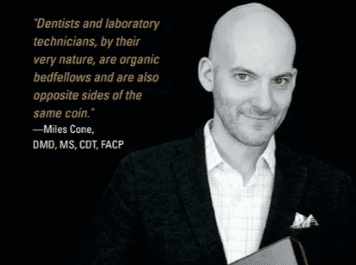
Miles Cone, DMD, MS, CDT, FACP
What recent advancements in dental technology have you found most impactful?
Anyone who has ever seen me lecture or who has followed me on social media over the last decade knows that for years I was really opposed to digital dentistry. In the last year or so, however, my practice manager (who just so happens to be my wife), insisted that I find an alternative to all the analog protocols that were binding me at the office, keep me away from the family, and slowly grinding me down. The decision to incorporate an intraoral scanner, 3D printer, and other digital technologies into our practice created an immediate positive financial and mental impact that cannot be understated.
What common misconceptions do dental technicians have about the clinical side of dentistry, and vice versa?
The grass is ALWAYS greener on the other side, right?
For the technician’s consideration: I think there is a common misconception regarding dentists (and most clinicians in the healthcare industry) that we make so much money, and we have this extremely cush lifestyle, and how nice it must be to be able to take a vacation whenever we want. What many technicians don’t consider is that a dentist’s revenue potential is dictated and bound by a physical practice location and limited office hours. After 4-5p.m., clinicians stop making money. An independent ceramist, however, while they may take phone calls from the dental office during the day, can choose to work any hours they like from the comfort of their home, head to the beach to treatment plan implants, design restorations on their laptop, and be productive long after the close of business for most dentists (including weekends). Something else that dental technicians may never be able to fully appreciate, or experience is the crushing weight and mental toll of patient demands, and high expectations we are burdened with. Every day. All day. Several days a week. Those dentists who everyone says are only doing it for the money and don’t care about their patients, even they lose sleep (and their hair), develop ulcers, and travel down a dark and winding road of self-doubt and depression when cases and procedures don’t go well, all while trying to mitigate the potential for lawsuits. Most dentists are small-business owners as well, and while it may seem appealing to be able to take vacation on a whim, it is also extremely stressful because we are hemorrhaging money while we are out of the clinic. For many technicians who work for someone else, the “joys” of running payroll, hiring, and firing employees, cost calculations for advertising and overhead, all while trying to remain profitable, are an affliction (albeit, self-imposed) that I wouldn’t wish on my worst enemy.
For the clinician’s consideration: One of the biggest misconceptions/slights that clinicians have about technicians is that they are “just a tech”. Dentists often create this education hierarchy which positions the technician at a lower tier and creates inequitable professional balance. This is not a good way to begin a collaborative relationship. While I do believe that the art and science of dentistry go hand in hand, the science is something that can be learned by most anyone from a textbook; the art aspect, however, is more innate, and developing the skill to a professional level may not be a reality for most individuals. As a personal anecdote to illustrate my point – the CDT exam is the only test I have ever failed, while I passed my prosthodontic boards on the first go without much effort. Knowing what it is like to prep a single central and subsequently layer the ceramic to achieve an acceptable match for that single central does not require equal abilities. I am often grateful that I don’t have the unenviable task of fabricating many of my own restorations anymore.
For dentists and technicians, the door swings both ways. There are pros and cons to each side of the equation, and what each member of the clinical and laboratory team needs to understand first and foremost is that there is a human being attached to the other end of these white things that we put in their mouth.
What future trends do you foresee in the integration of dental technology and the clinical side?
You can’t discuss dental technology in the clinic without talking about the role that artificial intelligence (AI) is going to play. We are already witnessing tremendous impact with AI in radiographic diagnostic procedures (e.g. caries detection and periodontal disease), and we are rapidly moving forward with AI designs for nightguards and single-unit indirect restorations. Shade selection for hard and soft tissues utilizing digital colorimeters/spectrophotometers coupled with analytical laboratory software is also a hot topic right now and is showing incredible promise.
How do you envision the role of dental technicians evolving in the next decade?
If I am being very honest, I envision a split dichotomy on the clinical side, as well as the laboratory side of our profession. In the next ten years, I believe dentists will either work with a few extremely small, customized, and bespoke dental technicians, or they will send their cases to large production labs. I can’t envision a future where mid-tier dental laboratories exist. I suspect this will also be true for patients when choosing their oral health providers. Patients will either pay top dollar for treatment at a high-end fee for service dental clinic, or they will be directed to a larger Dental Service Organization (DSO) that will accept their insurance plan.
What do you find most rewarding about being both a dentist and a dental technician?
Dentists and laboratory technicians, by their very nature, are organic bedfellows and are also opposite sides of the same coin. Possessing insights into what goes on at their chair and the bench has therefore played an invaluable role in my treatment planning philosophies as well as the protocols I follow in the fabrication of various prosthetics for my patients. Many restorative dentists have endeavored to improve their clinical skills in the way of better tooth preparations, aligner therapy, sleep medicine, or surgical procedures, for example. I feel that my non-traditional role as a dental technician, albeit a departure from prediction, has been pivotal in my growth to understanding not just the science, but the artistic aspect of this amazing profession.
This article was originally published in the October 2024 issue of the Journal of Dental Technology